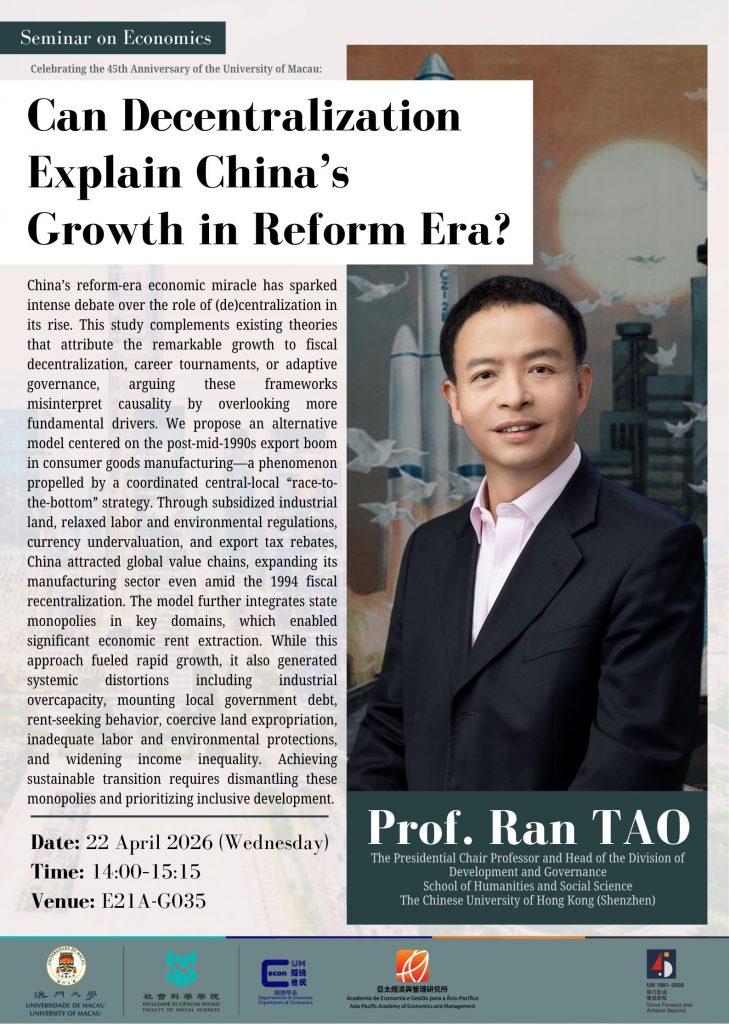
FSS-DECO Seminar: Can Decentralization Explain China’s Growth in Reform Era?
Speaker: Prof. Ran TAO, The Presidential Chair Professor and the Head of Division of Development and Governance, School of Humanities and Social Science, The Chinese University of Hong Kong (Shenzhen)
Date: 22 April 2026 (Wednesday)
Time: 14:00-15:15
Venue: E21A-G035
Language: English
Abstract: China’s reform-era economic miracle has sparked intense debate over the role of (de)centralization in its rise. This study complements existing theories that attribute the remarkable growth to fiscal decentralization, career tournaments, or adaptive governance, arguing these frameworks misinterpret causality by overlooking more fundamental drivers. We propose an alternative model centered on the post-mid-1990s export boom in consumer goods manufacturing—a phenomenon propelled by a coordinated central-local “race-to-the-bottom” strategy. Through subsidized industrial land, relaxed labor and environmental regulations, currency undervaluation, and export tax rebates, China attracted global value chains, expanding its manufacturing sector even amid the 1994 fiscal recentralization. The model further integrates state monopolies in key domains, which enabled significant economic rent extraction. While this approach fueled rapid growth, it also generated systemic distortions including industrial overcapacity, mounting local government debt, rent-seeking behavior, coercive land expropriation, inadequate labor and environmental protections, and widening income inequality. Achieving sustainable transition requires dismantling these monopolies and prioritizing inclusive development.