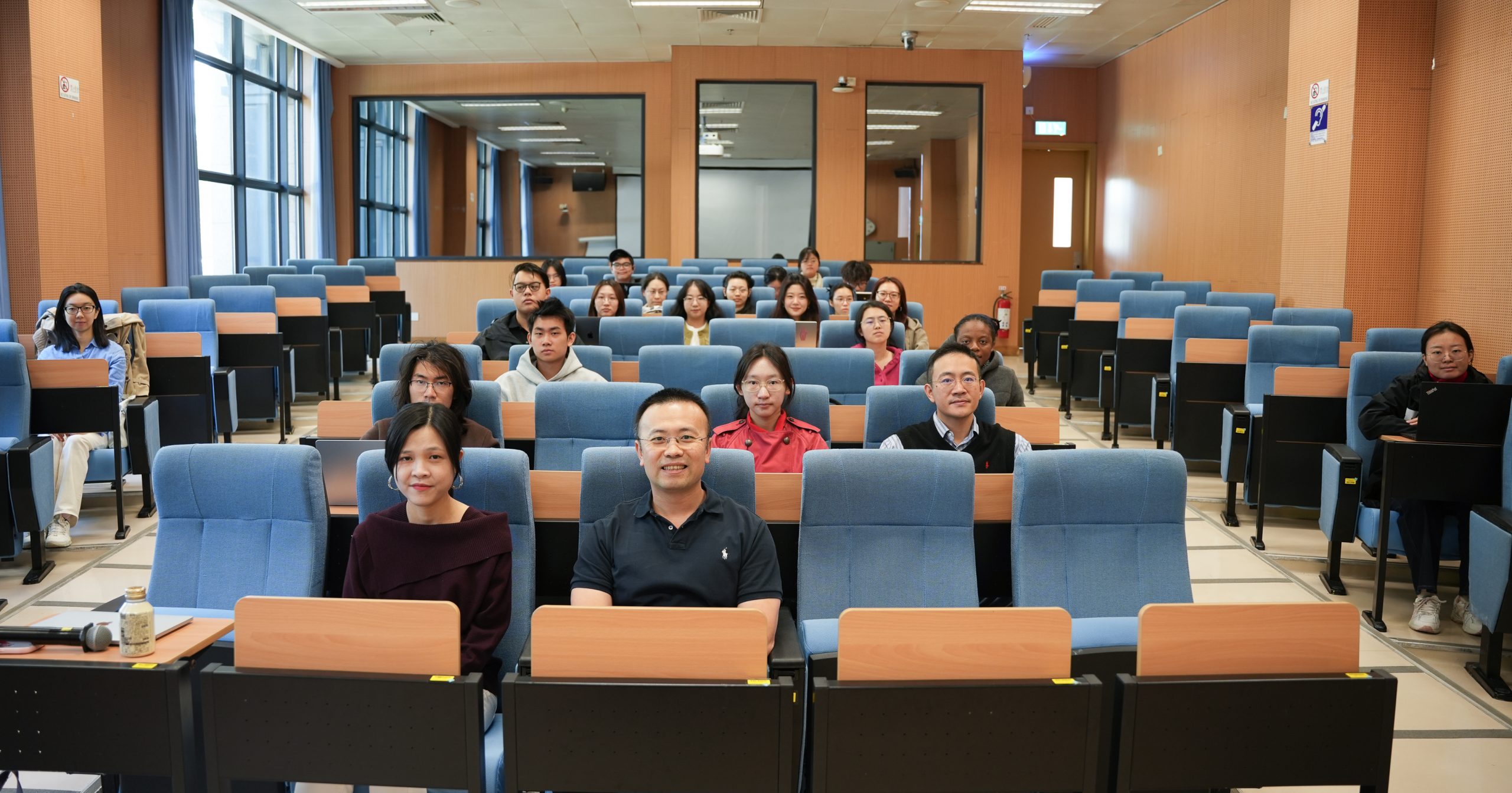
In the third Computational Social Science Workshop of this academic year hosted by the Faculty of Social Sciences at the University of Macau, assistant professor Ling Zhu from the Department of Sociology at the Chinese University of Hong Kong was invited to present a methodological study. Her research focuses on the current applications, core challenges, and improvement strategies for modularity scores in social networks and offers key methodological guidance for scholars in related fields.
Prof. Zhu pointed out that comparing modularity scores across networks runs into various conceptual and empirical issues. Conceptually, these scores may not align with the substantive concepts that social scientists interested in. Empirically, the estimated optimal modularity scores across social networks are highly sensitive to the algorithms employed and network characteristics that are irrelevant to those substantive concepts, hence biasing the comparison results. This manifests in three key problems: conceptual dependency, algorithmic dependency and network dependency. To demonstrate these issues, Prof. Zhu drew on a study of occupational mobility in the U.S. labor market from 2020. The original research claimed that occupational mobility boundaries had tightened after 2000. While upon reanalysis, she found that the study had overlooked changes in network features over time. Evaluated by bootstrap procedures, the actual data revealed a more flexible labor market, showing more frequent mobility within occupational subgroups.
To address these challenges, Prof. Zhu proposed a multi-step strategy to overcome the issues identified: matching research concepts with appropriate measurement methods; separating community detection and modularity calculation, and then using standardization and simulations to minimize interference from network features. She stressed that comparing modularity scores across networks is possible, although it requires methodological rigor.
Prof. Ling Zhu is an assistant professor in the Department of Sociology at the Chinese University of Hong Kong. Her research interests include Chinese society, computational social science, economic sociology, organizations and work, and political sociology. Her work has been published in top journals in the field, such as Chinese Sociological Review, Social Science Research, Chinese Journal of Sociology, and Society.