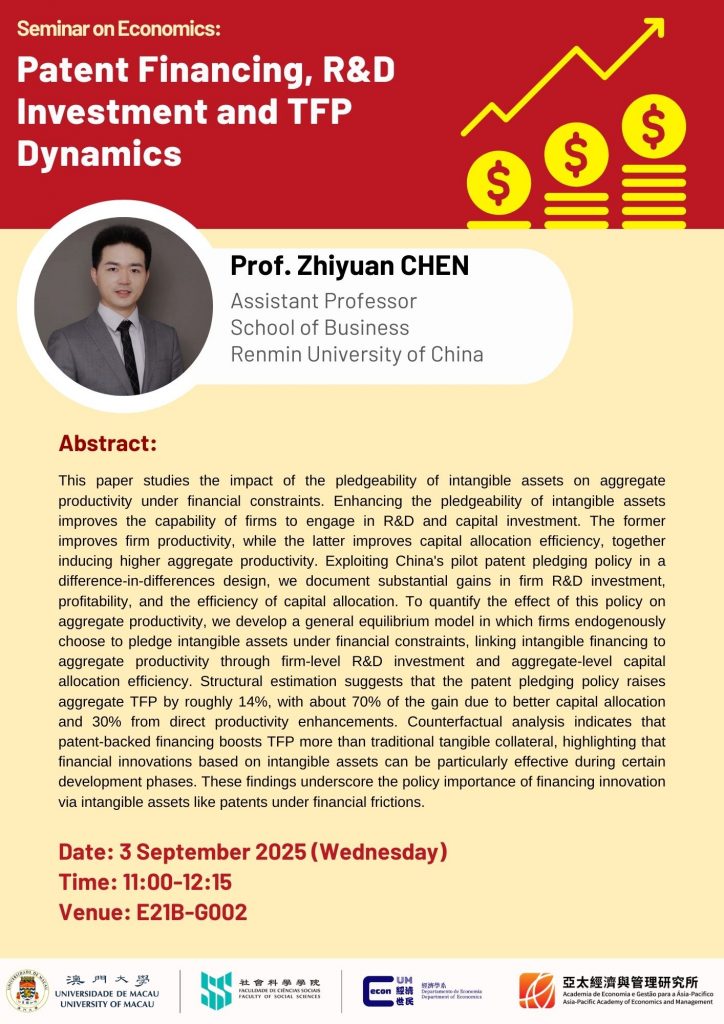
FSS-DECO seminar: Patent Financing, R&D Investment and TFP Dynamics
Speaker: Prof. Zhiyuan CHEN, Assistant Professor, School of Business, Renmin University of China
Date: 3 Sep 2025 (Wednesday)
Time: 11:00-12:15
Language: English
Venue: E21B-G016
Abstract: This paper studies the impact of the pledgeability of intangible assets on aggregate productivity under financial constraints. Enhancing the pledgeability of intangible assets improves the capability of firms to engage in R&D and capital investment. The former improves firm productivity, while the latter improves capital allocation efficiency, together inducing higher aggregate productivity. Exploiting China’s pilot patent pledging policy in a difference-in-differences design, we document substantial gains in firm R&D investment, profitability, and the efficiency of capital allocation. To quantify the effect of this policy on aggregate productivity, we develop a general equilibrium model in which firms endogenously choose to pledge intangible assets under financial constraints, linking intangible financing to aggregate productivity through firm-level R&D investment and aggregate-level capital allocation efficiency. Structural estimation suggests that the patent pledging policy raises aggregate TFP by roughly 14%, with about 70% of the gain due to better capital allocation and 30% from direct productivity enhancements. Counterfactual analysis indicates that patent-backed financing boosts TFP more than traditional tangible collateral, highlighting that financial innovations based on intangible assets can be particularly effective during certain development phases. These findings underscore the policy importance of financing innovation via intangible assets like patents under financial frictions.